Monitoring the Situation
Despite my best intentions, it turns out I've been much too busy monitoring the situation to write a blog.


A funny thing happened to me on the way to the CMS…
As discussed in the previous episode, I decided to start a blog with a view to renewing with the ideals of owning one's own sovereign digital identity online, and more prosaically to simply explore the hobby of writing and have fun setting up a domain and website. The intersection of technology and the liberal arts as Steve Jobs might have put it. In the intervening weeks however, as I have become acquainted with the amusing discourse surrounding the cultural practice of monitoring the situation, it has slowly dawned on me that my favourite new app has me spending more time monitoring the situation than producing the posts that I expected to be writing. But I can explain.
In retrospect, starting a website was the culmination of a multi-year process of re-engaging with the internet that began, mostly without my noticing, during the pandemic years. Although my first experiences with the internet go back to the mid-nineties, and at the time it was probably the most amazing and wondrous thing I had ever experienced, there haven't been that many periods during which I have been so captivated by the internet that you would describe me as being terminally online or even very online — especially since those terms didn't exist for most of that time. But I have always been somewhat online, to be sure.
However there were two overlapping periods during which I was very much enamoured with the internet: the golden age of blogs and RSS and the early days of Twitter. If you distill them down to their essence, both RSS and the original Twitter were in a sense very similar things: reverse-chronological feeds of content that you had explicitly chosen to follow. So simple, and yet so fleeting.
When push comes to shove
In the case of RSS, the content was comprised of feeds published by blogs, news outlets, Flickr accounts and anything else you could structure in an updatable public XML file (a fun fact that you might not realize is that podcasts, to this very day, are merely RSS feeds that contain the URLs of audio files instead of blog posts). The magic of the thing was that, instead of always needing to check your favourite websites to see if anything new had been published, you could simply subscribe to their feed in a piece of software known as a feed reader, and whenever any of the websites you followed published anything, you would see it in your reader. This was so widespread at one point that I distinctly remember Firefox lighting up an RSS icon in the address bar when it detected that the website you were visiting had a feed, making it easy to grab it and plug it into your reader app. Once you had it set up with all your favourite blogs and other sources of content, you could just sit back and let it all come to you. There had been other attempts at implementing this kind of push technology — I vaguely remember something called PointCast being hyped up at one point — but RSS was peak, and it was magical.
RSS readers were originally pieces of software that you would install on your computer, but by the time I had ascended to the level of enlightenment at which one adopts RSS, Google Reader was already a going concern — a web app that was to RSS as Gmail had been to email a few years earlier. In Google Reader you could organize your individual feeds into different thematic folders and view them that way, but I preferred to consume the raw river of news, a pure reverse-chronological feed of every source of content I had chosen to follow: book reviews from France next to blog posts from Boing Boing next to the footie news from England — a glorious mix of everything I was interested in, all in one place, continuously updated and endlessly compelling.
A little bird told me
While all of this was happening, a plucky upstart social network called Twitter came along — a microblogging platform that served you a reverse-chronological feed of posts from accounts that you followed. Eventually those micro blog posts could also contain things like links, photos and videos, so there was some overlap with RSS in that those links could be to things like news articles; but because they were being posted as micro blog entries it somehow felt more personal. Indeed, at the very beginning of Twitter if I recall correctly, the idea was to post status updates in the third person. If someone posted is eating a sandwich, in your feed you'd see username is eating a sandwich. No @ symbol yet, that was a user-created convention, possibly derived from IRC, that would come later. The reason they were micro blog posts in the first place was that Twitter was conceived as a service on top of SMS — the original text messaging system for mobile phones that had a 160 character limit — thus limiting Twitter posts to 140 characters to allow for a username to accompany each message.
I was aware of Twitter pretty early on, and remember hearing about the hot new thing whatever year it was that it blew up at SXSW — perhaps the same year Leo Laporte did those pioneering livestreams out and about in Austin with a 20-pound backpack sourced from Ustream that culminated in the first-ever live-streamed crowdsurf (EDIT: those livestreams actually happened three years later). Despite that awareness, I still ended up being a bit late to the party — but was nonetheless early enough to have originally sent and received tweets via SMS using a Nokia 6300 instead of via an app on a smartphone, and certainly early enough to have been there before the arrival of a certain musky boy.
In 2010 I finally got my first smartphone, the enduringly appealing iPhone 4 which, as an aside, is still one of my favourite pieces of technological industrial design of all time, on par with the glory days of Sony. Soon I would be scrolling Google Reader in mobile Safari and Twitter in Tweetbot on my pocket computer — I was living in the future, and the future was good.
Antisocial Networking
But those halcyon days were short lived, and it wasn't long before it all fell apart. In 2013 Google shut down Reader, as they tend to do most things, perhaps judging that RSS had become irrelevant in the age of ascendant social media. Concurrently, Twitter slowly but surely began its transformation into the hellscape we know today. As the unwashed masses came piling in, the vibe underwent a shift — in ways both innocuous and horrifying — while the platform gave only occasional, tepid nods in the direction of content moderation, seemingly more interested in enshittifying the thing to the hilt by injecting the timeline with ever more ads and algorithmically promoted slop and rage bait, foisted upon users by default in place of the original reverse-chronological feed. Of course power users knew how to revert to the original timeline, and many of us were using third-party apps regardless, but we were an increasingly small minority of the overall user base. Then finally, following previous API drama in which Twitter attempted to screw over the third-party devs that had made them successful in the first place (early Twitter had no app of its own and took off thanks to third-party apps), that musky boy came along and killed them off for good as a prelude to ushering in the current dark age of endless horrors on perhaps the worst website on the internet. Somewhere along the way, perhaps without even fully realizing it, I mostly gave up on social networking.

Social Engineering
Much later, I did eventually sign up for Mastodon and then Bluesky. Among the people I used to follow on Twitter, it's been fascinating to see how they've self-sorted into Mastodon and Bluesky communities — essentially tech people to the former and media people to the latter. From what I hear, normal people and celebrities who cared enough to leave Twitter have ended up on Threads, but I don't know much about that outside of the handful of Threads accounts that I follow from Mastodon via federation over ActivityPub. Speaking of which, I'm kind of fascinated by the decentralized nature of Mastodon and the broader ActivityPub fediverse. The fact that this blog is itself an actor in the fediverse that can be followed directly from Mastodon (@journal@orthographi.ca if you're curious) is a source of endless wonder and satisfaction to me, both on a philosophical and technical level. And using Ivory as my Mastodon client — from the former devs of Tweetbot who were among the victims of the closing of the Twitter API — has made it feel just as polished, if not more polished, than my previous experiences with Twitter.
By contrast, I don't really understand what Bluesky is trying to accomplish with their AT Protocol and am mostly there as a matter of form, without the same level of enthusiasm. That being said, from what I understand it is at least an open platform that allows for third-party clients, and I have adopted the aesthetically pleasing Skyscraper as my app of choice.

A rich tapestry, indeed
Now we finally get to the point of this interminable post. During my post-Twitter wanderings in the desert, while I was out touching grass, reading books and running ultramarathons, it did occasionally cross my mind that I should try to get back into RSS. I tried a couple of feed aggregators after Google Reader shut down, but at the time nothing stuck. Like a lot of people back then, I was probably too interested in Twitter to invest much effort into finding a suitable RSS reader. Quite recently, there has been a growing chorus of commentary extolling the virtues of RSS, both from old hands and newcomers alike.
Concurrently, as previously discussed, as if possessed by some unknown force, I decided to register a domain and start a website. Carried along by that same momentum, the time had finally come for me to find an RSS reader and fully re-engage with the web. Despite recurring controversies positing that the very suggestion that writers should also be readers is ableist actually, I nevertheless probably had some subconscious notion that I should get back to reading more of the web if I was going to start writing on it. I had long been aware that the venerable NetNewsWire was the gold standard for RSS readers on Apple platforms, but before I could fully put it through its paces I got completely addicted to a different kind of feed reader, a relatively new app called Tapestry.
Tapestry is made by The Iconfactory, another one of the aforementioned third-party devs that was screwed over when Twitter killed their API. To say that they were influential in the development of Twitter would be an understatement — from what I recall, their app Twitterrific was one of if not the first Twitter app, years before Twitter would purchase Tweetie and rebrand it as the official app. They also pioneered such fundamental Twitter things as posts being called tweets, the blue bird logo and possibly even the very concept of scrolling a social feed on a phone.
The death of the Twitter API seems to have plunged the company into an existential crisis, but they went back to the drawing board and returned with the brilliant Tapestry, an app I would describe as a reader for all feeds: RSS, Mastodon, Bluesky, YouTube, Hacker Newz, Reddit, Tumblr — really, anything you care to throw at it. The linchpin of the whole thing is a system they call connectors, a sort of open standard that anyone can program for, that enables essentially any kind of feed-like content from the web to be packaged for use in Tapestry. And the result is glorious: I feel like I'm living in a world where the golden age of Twitter was integrated directly into Google Reader.
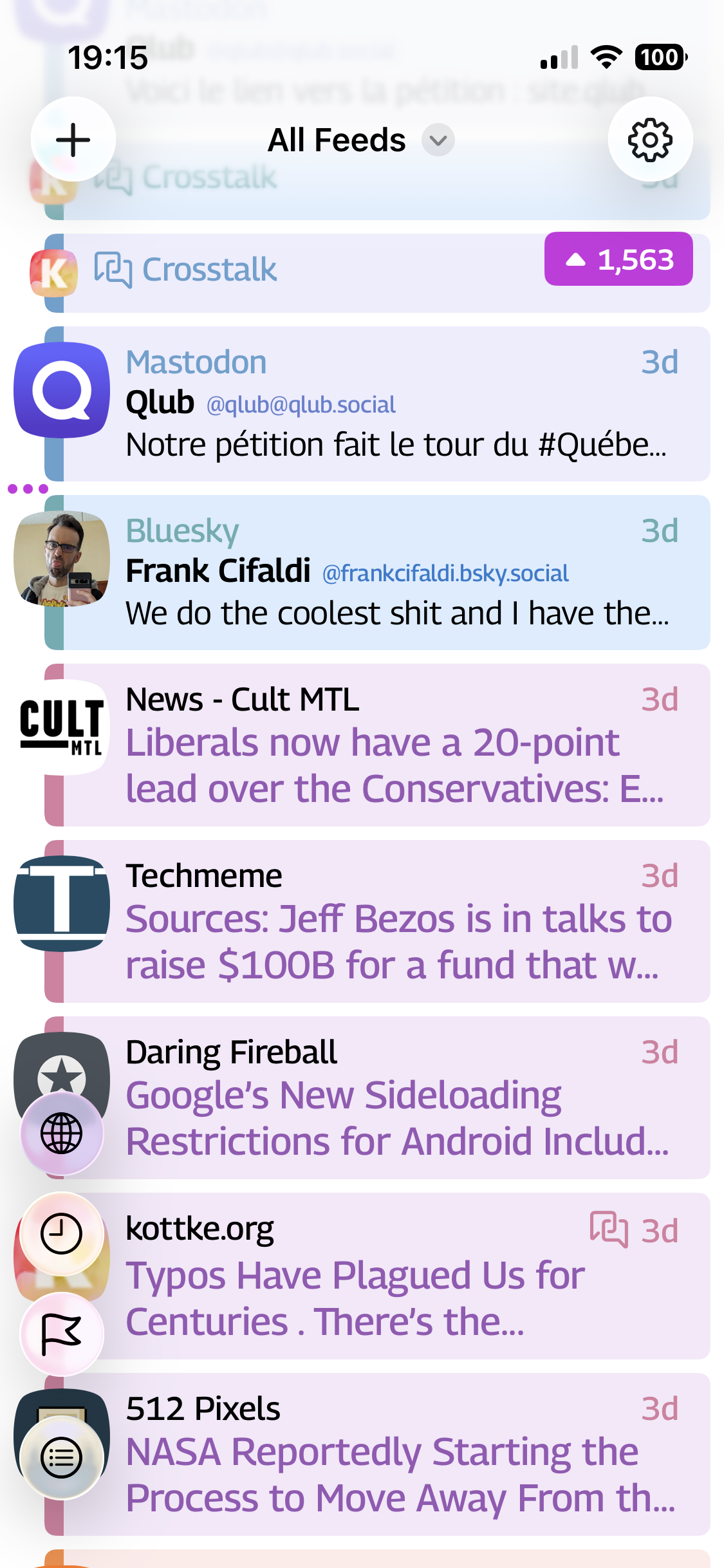
In addition to its bright, colourful design, Tapestry has some very helpful features including the feed finder that will attempt to automatically import a suitable Tapestry feed for any URL you give it, as well as the impressively thoughtful crosstalk for hiding duplicate feed items. If for example you subscribe to someone's blog via RSS, and also follow them on Mastodon and Bluesky, it's possible that new blog posts could appear three times in your Tapestry feed. But with crosstalk enabled, Tapestry tries to detect multiple instances of identical content in your timeline and only show one of them, hiding the others behind expandable entries simply labelled crosstalk, thereby allowing for more efficient and enjoyable parsing of one's feed. For social media posts, a swipe left opens the full thread of replies if applicable, while a swipe right opens the post in the app of your choosing for further interaction. The latter gesture creates a pretty magical experience on iPadOS 26 with the new windowing mode, allowing Tapestry, Mastodon and Bluesky to be set up side by side in a stage manager workspace. Although I believe it was originally conceived of as an iPhone app, and it has a Mac version as well, the iPad is where Tapestry has really clicked for me.
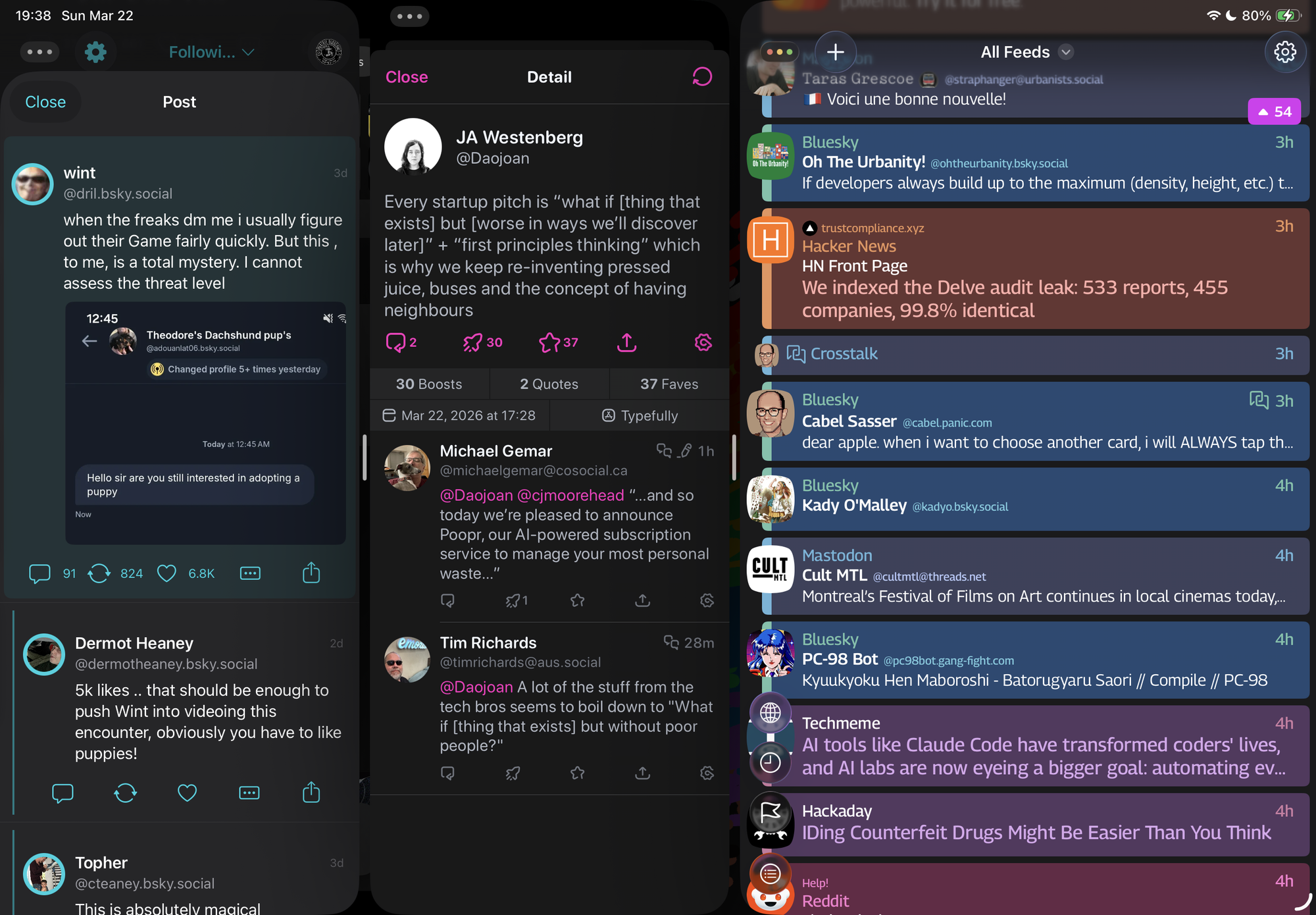
So I now have a reverse-chronological feed of my RSS subscriptions, mixed in with my Mastodon and Bluesky feeds (among other things), constantly updated and endlessly compelling. Sounds ideal, right? The only problem is I can't look away and have been spending all of my time monitoring the situation in Tapestry instead of writing my blog. But in the end, my inability to write ended up providing the subject matter to be written about so… swings and roundabouts, I guess?
As with any addiction, the first step to recovery is admitting you have a problem. Hopefully going forward I can find a better balance between reading and writing, but regardless of how that turns out Tapestry remains the most engrossing app I have used in a very long time.